


Garden Seeder and Jab Planter - Selection, FAQ, and more
How to choose the best type for your garden.
We offer two types of seeder or planter for gardens and small farms. The Hoss Seeder (also called a push planter) has wheels and is rolled down the garden row to plant evenly spaces seeds. While the Jab Planter is a tall light device that you move to each spot where you want to plant a seed.
Click here to jump down to the FAQ section
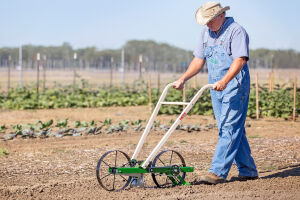
Garden Seeder
The Hoss Garden Seeder, is a full-time seeder with a heavy-duty steel frame and rolling disc for opening the furrow. It comes complete with wooden handles and 6 of the most common seed plates.
Options include a wide variety of seed plates, and an adjustable Row Marker.

Jab Planter
Quickly plant lots of corn, beans, sunflowers, and other medium-sized seeds. Both the number of seeds and the planting depth can be preset. Uses a gentle "push-down / lift-up" action.
The unit that also side-dresses with fertilizer is currently unavailable.
Frequently Asked Questions (FAQ) About Seeders and Planters
Click or tap a question below to see the answer.
Garden Seeder section: Click to jump down to the
What is a garden seeder?
How do garden seeders work?
How do you properly use a seeder?
What are the benefits of using a garden seeder?
Why do seeders have a rear wheel that rolls over the seed furrow?
Can you do no-till planting with a garden seeder?
What is the best garden seeder?
What is the best seeder for a beginner?
What is a seed drill?
Can you plant potatoes with a seeder?
What is the difference between a seeder and a planter?
Jab Planter section:
What is a jab planter?
What is a jab planter used for?
How do you use a jab planter?
Can you do no-till planting with a jab planter?
What is a garden seeder?
- A garden seeder is a small wheeled machine that is pushed by hand through the garden to plant seeds in a row. It is also called a push planter.
- Click to learn about our Garden Seeder
How do garden seeders work?
- Garden seeders work by performing three operations simultaneously: opening a furrow, metering single seeds down to the furrow at a preset spacing, and covering the furrow to protect the seeds. All seeders handle medium sized seeds (corn, beans, peas, etc) well, but only a few can handle small seeds (broccoli, cabbage, spinach, etc) well.
How do you properly use a seeder?
- To properly use a garden seeder, first take the time to correctly adjust and test all the settings.
– Check the seed metering mechanism by verifying that you have the right seed plate or roller installed.
– Then put seeds in the hopper and prop up the rear end of the seeder so you can rotate the drive wheel to make sure that seeds are falling in the right quantity at the correct spacing.
– Also check the planting depth by emptying the hopper (no seeds) and pushing the seeder a short distance through your garden then stopping and lifting the seeder out of the way to measure the furrow depth.
What are the benefits of using a garden seeder?
- The benefits of using a garden seeder are consistency and speed. A seeder can plant seeds at a consistent depth and spacing to maximize your crop's yield. A seeder is also much faster than hand seeding which reduces your labor.
Why do seeders have a rear wheel that rolls over the seed furrow?
- The rear wheel of garden seeders roll over the planted furrow to provide some compression of the soil around the seeds. Good seed-to-soil contact is important because it speeds up germination and prevents the roots of young plants from drying out.
- Click to see our article: Seed to Soil Contact is Important
Can you do no-till planting with a garden seeder?
- No, garden seeders are not recommended for no-till planting. Being fairly light hand pushed machines, they don't have the weight or force to open a furrow through compacted soil or soil bound together by the matted roots of the previous crop and weeds.
What is the best garden seeder?
- The best seeder for you will depend on the size of your garden and the seeds you want to plant.
– There three seeders commonly available in the US. They are the Earthway (and it's copycats), the Hoss, and the Jang.
– For small gardens, the Earthway or Hoss is best, while for large gardens the Hoss or Jang is best.
– If you are only going be planting medium sized seeds (corn, beans, peas, etc) all three brands can do that well, but if you also want to plant small seeds (broccoli, cabbage, spinach, etc) then the Hoss or Jang is recommended. - Click to see our article: Garden Seeder Buying Guide
What is the best seeder for a beginner?
- The best seeder for a beginner is the Hoss seeder or the Earthway. Both are simple to set up and use. Both will handle medium sized seeds (corn, beans, peas, etc) well. The Hoss will also plant small seeds (broccoli, cabbage, spinach, etc) well.
- Click to see our article: Garden Seeder Buying Guide
What is a seed drill?
- A seed drill is the earliest version of a seeder. It is still used in farming to plant crops that do not need accurate or consistent spacing, like a field of wheat or oats. A seed drill just randomly dribbles seeds out either fast, medium, or slow. In contrast, a seeder precisely meters out individual seeds at a preset rate and spacing.
Can you plant potatoes with a seeder?
- No, you can't plant potatoes with a garden seeder. Potatoes are normally planted as as cut pieces of a mature potato, not from seeds. There are a few medium-scale powered walk-behind machines that can plant potatoes in small fields.
- Click to see our article: Potato Planting and Harvesting
What is the difference between a seeder and a planter?
- A seeder is a wheeled machine that you push by hand to sow a row of seeds. A planter is a smaller tool that is pressed into the soil to open a small hole that a seed is dropped into. It is normally called a Jab Planter and the seeds can be fed either by hand or by a mechanism activated by the up-down stroke of the tool.
What is a jab planter?
- A jab planter is a handheld tool used for planting a seed in one spot a time. It is often used for seeding plants that need to be spaced far apart like melons and cucumbers. It features a “beak” that is pressed into the soil to create a hole, then opened to deposit a seed. The seeds can be dropped down through the tool manually, or they can be metered out with a mechanism that dispenses a single seed each time the planter is cycled.
- Click to learn about our Jab Planter
What is a jab planter used for?
- A jab planter is used for planting garden seeds for crops that are spaced far apart, for planting on mounds or hills, and for filling in empty spaces in rows that were skipped by farm seeders. They are sometimes used in gardens by people who can't lean over long enough to plant their rows with their fingers. They are also used by gardeners as a lower cost alternative to conventional garden seeders.
- Click to see our article: Why I Still Use a Jab Planter
How do you use a jab planter?
- The method for using a jab planter depends on whether it is an automatic or manual model.
– An automatic planter is simply positioned where you want to plant your seed, then it's handles are pressed down to the bottom of it's stroke. The downward pressure is then relaxed and a seed is deposited in the hole as the unit's spring raises the body of the jab planter back to it's resting position.
– The method for using a manual jab planter also starts with placing the tip of the unit where you want to plant a seed. The the planter is pressed downwards to sink the the tip of the unit into the soil. A seed is then dropped into the planter's feed tube and falls to the bottom of the tip. The operator then operates a lever or trigger that opens the tip to deposit the seed into the hole, and the planter is then lifted clear of the ground."
Can you do no-till planting with a jab planter?
- In some cases, yes you can do no-till planting with a jab planter. The soil must be loose enough to allow the tip of the planter to easily enter the soil, and then open up to drop a seed. So the soil can not be compacted or dried into a thick hard surface. The soil can also not be tightly matted together by roots as that would prevent the tip from opening.
See all of our:
Click for all:
See the:
How does your Hoss seeder/planter compare with other brands?
Very well, thank you. The two other common push seeder brands are the Earthway and the Jang. See detailed comparison
All three do a good job with the big seeds (corn, peas, beans), but the Hoss and Jang are much better at small seeds.
Sandy or fluffy roto-tilled soils make it tough to get traction, so a large diameter drive wheel is needed to compensate, and the Hoss Garden Seeder has the largest.
Lastly there is cost: the Earthway is the cheapest, the Hoss is in the middle, and the Jang is the highest cost.
Connect with us!

